2026/27 Concert III
Mahler’s Farewell
About the performance
“It is music coming from another world, it is coming from eternity” declared conductor Herbert van Karajan of Gustav Mahler’s last completed symphony. For composer Arnold Schoenberg, Mahler “hardly speaks as an individual any longer. It almost seems as though this work must have a concealed author who used Mahler merely as his spokesman, as his mouthpiece.” With the 9 th Symphony SPM continues our biannual Mahler cycle. Those who have heard SPM’s recent performances of his 6th and 3rd symphonies will know the expressiveness, artistry and commanding skill that the players will bring to this work. Prepared to be deeply moved by the last movement, which is clearly Mahler’s farewell to the world and his anticipation of heavenly life. The concert will open with a work featuring our distinguished string section: Mozart’s Adagio and Fugue in C Minor.
Mozart. Adagio and Fugue in C minor for string orchestra
Mahler. Symphony No. 9
Featuring
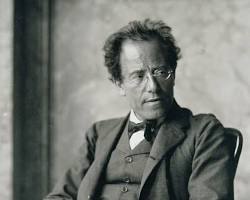
Composer Gustav Mahler
Austrian composer and conductor Gustav Mahler (1860–1911) was one of the most significant composers of the early 20th century. Though he only found popular success in the last few years of his life, today many of his works, particularly his symphonies, are cornerstones of the orchestral repertory.
Mahler was born in Kalischt (now Kalište). He studied at the Vienna Conservatory and the Vienna University, where he began conducting. He obtained his first major conducting position in 1883 in Kassel. In 1885 he moved to Prague and then to Leipzig Opera in 1886, where his completion of Weber’s Die drei Pintos (1888) won him widespread renown. He was director of Royal Hungarian Opera in Budapest 1888–91 and chief conductor of Hamburg Stadttheater 1891–7. During that time he conducted the premieres of his Symphonies no.1 (1889) and no.2 (1895). In 1897 he converted from Judaism to Roman Catholicism and became director of the Vienna Hofoper. From 1903 Mahler’s growing popularity as a composer led to his increased absence from the Hofoper as he conducted premieres of his own works, including of Symphonies no.4 (1901), no.3 (1902), no.5 (1904) and no.6 (1906). Other works from this period include the Kindertotenlieder (1901–04). In 1907 he took up a position with the Metropolitan Opera, New York, and in 1909 with the New York Philharmonic Opera, returning to Europe in the summers, where he conducting the premieres of Symphonies no.7 in 1908 and no.8 in 1910. His final works Symphony no.9, Das Lied von der Erde and the incomplete Symphony no.10 were performed posthumously.
Mahler’s works straddle the Austro-German musical tradition and 20th-century modernism, and share a profound emotional power and range that have ensured his continuing popularity and influence.